★★★★★
★★★★★
Verified Buyer
Reliable, easy, quick, excellent. Thanks.
Uso del prodotto: Questo prodotto è destinato esclusivamente alla ricerca.
Tutte le informazioni sui prodotti presenti su questo sito hanno scopo esclusivamente educativo. Qualsiasi forma di introduzione nel corpo di esseri umani o animali è severamente vietata dalla legge. Questo prodotto deve essere maneggiato solo da professionisti abilitati e qualificati. Non è un farmaco, un alimento o un cosmetico e non deve essere etichettato, utilizzato o presentato come tale.
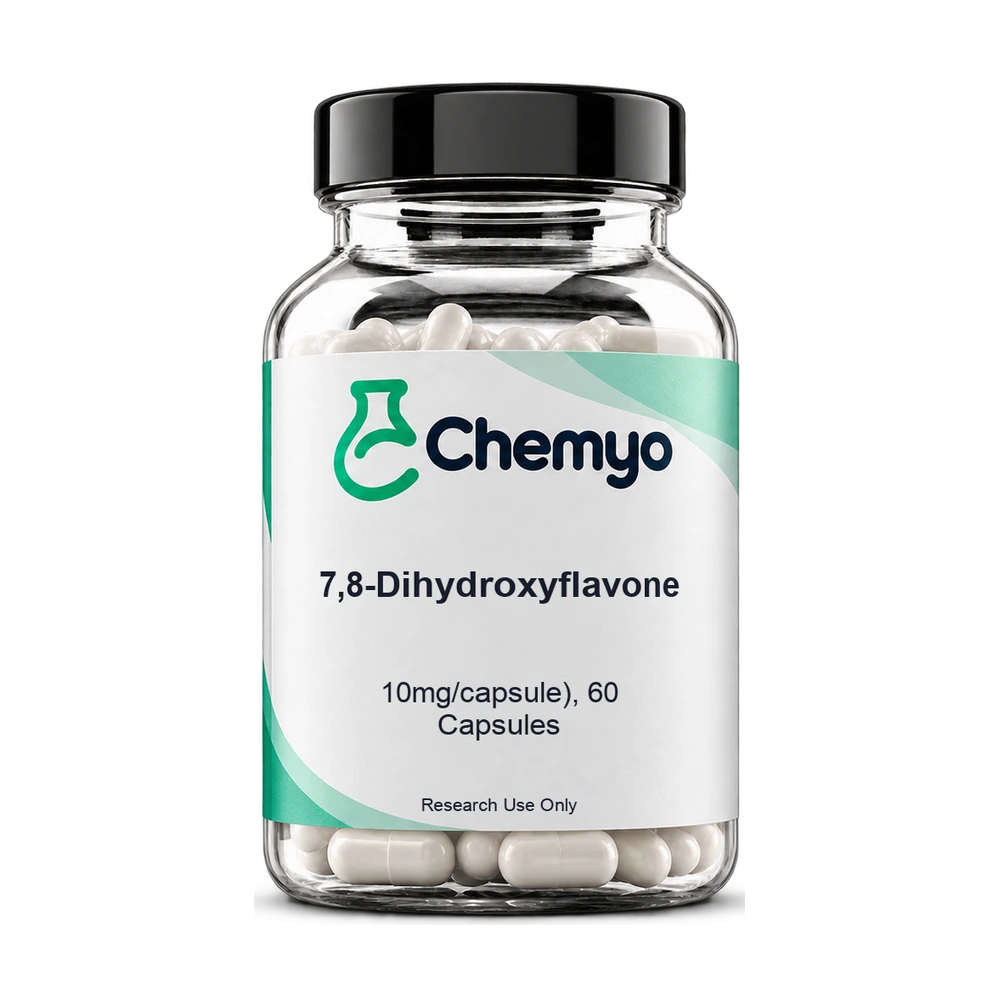
7,8-Dihydroxyflavone (7,8-DHF) is a flavonoid compound studied for specific molecular pathway interactions in experimental models, with laboratory research indicating selective TrkB receptor modulation properties.
Durante il cambio di confezione potresti ricevere prodotti con l’etichetta precedente o con quella nuova. Formulazione, purezza e qualità restano esattamente le stesse, secondo i nostri standard.
-25% su tutto – fino al 31 Ottobre
25% sui prezzi ordinari, in sostituzione degli altri saldi. Cumulabile solo con lo sconto crypto.
Spedizione in giornata per gli ordini USA effettuati entro le 12:00 EST.
Vedi le condizioni di spedizione →Ogni lotto è testato per purezza, potenza e qualità.
Vedi i risultati di laboratorio →7,8-Dihydroxyflavone (7,8-DHF) is a flavonoid compound studied for specific molecular pathway interactions in experimental models, with laboratory research indicating selective TrkB receptor modulation properties. Research interest centers on its proposed role as a tool compound for investigating TrkB receptor-mediated signalling distinct from peptide-based neurotrophic factor research.
Research applications include TrkB receptor pharmacology, comparative flavonoid receptor-modulator studies, and small-molecule neurotrophic signalling research.
| Chemical Formula | C15H10O4 |
|---|---|
| Synonyms | ADB6MA8ZV2, CHEMBL75267, Spectrum_001087, Spectrum2_000952, Spectrum3_000213 |
| CAS Number | 38183-03-8 |
| PubChem CID | 1880 |
| Total Compound Content | 600mg (10mg per 1 capsule) |
| Shelf Life | 36 months |
Every batch is independently lab tested for identity, purity and potency. View our lab testing program →
As a small-molecule flavonoid, 7,8-Dihydroxyflavone offers researchers a chemically stable alternative to peptide-based neurotrophic factor research tools, which often face stability and blood-brain barrier penetration limitations in experimental design. Comparative research examining both compound classes at the TrkB receptor allows investigators to characterise whether observed signalling outcomes depend on receptor engagement mechanism or are specific to one structural class of research tool.
Radioligand displacement assays and surface plasmon resonance are standard methods for quantifying 7,8-Dihydroxyflavone's binding affinity at the TrkB receptor, typically run alongside parallel assays at related receptor tyrosine kinases (such as TrkA or TrkC) to establish selectivity. These binding data are usually paired with cell-based functional assays measuring downstream receptor autophosphorylation to confirm that binding translates to receptor activation in the specific experimental model under study.
Western blot analysis of TrkB receptor autophosphorylation and downstream kinase cascade activation (such as ERK or AKT pathway markers) in neuronal cell culture models is a standard approach for confirming functional TrkB pathway engagement following compound exposure. These molecular signalling readouts are often paired with cell-based functional assays relevant to the specific research question, allowing researchers to connect receptor-level engagement to downstream cellular outcomes.
Reliable, easy, quick, excellent. Thanks.
Everything that I ordered 'till now was perfect.
The product and packaging were nice.
Incredibly fast delivery, incredible quality. Thank you.
Product was of high quality and potency. Shipping was fast. Transaction was top notch!
Fantastic results using the super fast shipping, the compound is pure and high quality. Results from my tests exceeded all expectations. A trustworthy supplier.
Highly recommend the super fast shipping, quality is stellar. Will buy again. The experimental results were exceptional.