Was still waiting on tracking after 6 days. When told it would be 3. It says on website a reship If taken at customs. And I would hope they would honor...but unfortunately I haven't heard anything besides wait. Even after showing proper documentation.
Utilisation : Ce produit est destiné uniquement à la recherche.
Toutes les informations sur les produits présentes sur ce site sont fournies à titre éducatif uniquement. Toute forme d’introduction dans le corps humain ou animal est strictement interdite par la loi. Ce produit doit être manipulé uniquement par des professionnels agréés et qualifiés. Il ne s’agit pas d’un médicament, d’un aliment ou d’un cosmétique et il ne doit pas être présenté, utilisé ou étiqueté comme tel.
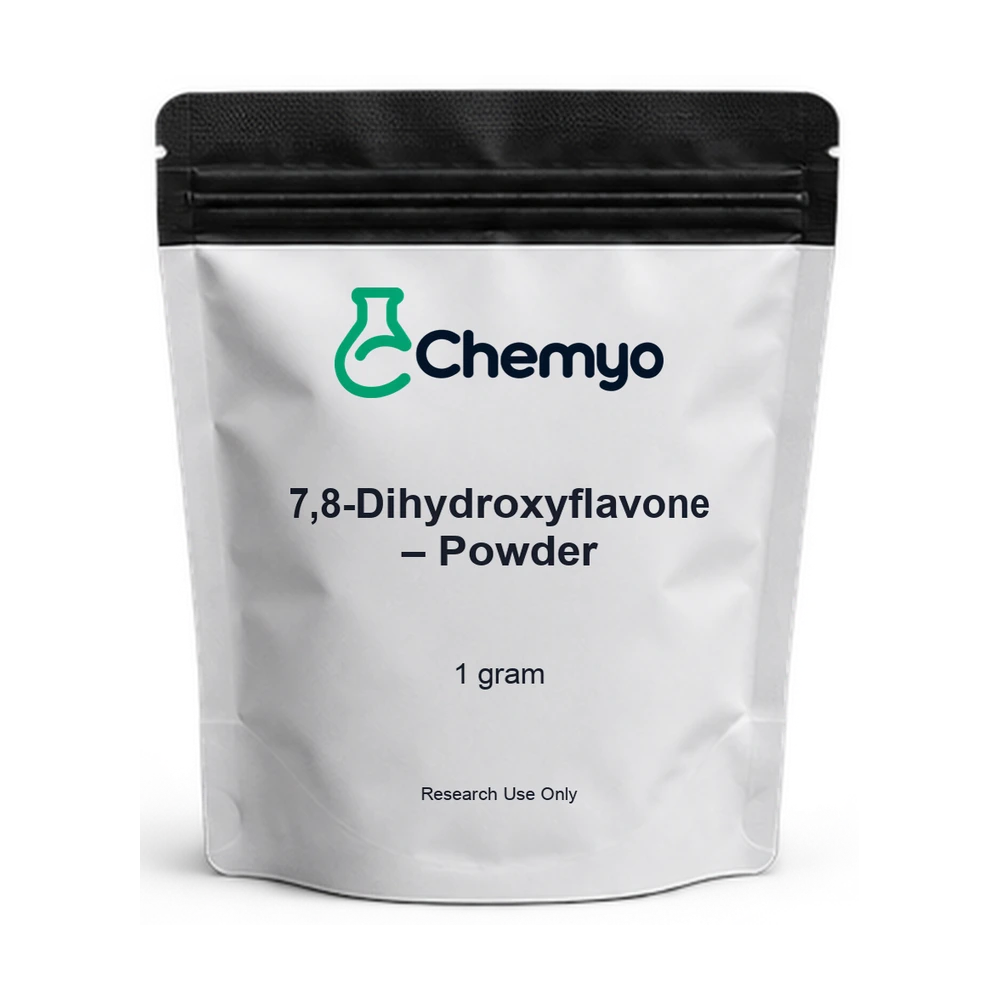
7,8-Dihydroxyflavone – Powder, 1 gram
7,8-Dihydroxyflavone (7,8-DHF) is a flavonoid compound studied for specific molecular pathway interactions in experimental models, with laboratory research indicating selective TrkB receptor modulation properties.
Pendant notre changement d’emballage, vous pouvez recevoir des produits avec l’ancienne ou la nouvelle étiquette. La formulation, la pureté et la qualité restent exactement les mêmes, selon nos standards.
- Carte de crédit
- Virement bancaire (SEPA instantané)
- Virement bancaire (ACH)
- Wise
- Revolut
- Zelle
- Remitly
- Western Union
- Chime
- Autres
-25% sur tout – jusqu’au 31 octobre
25% sur les prix habituels, en remplacement des autres soldes. Cumulable uniquement avec la remise crypto.
Expédition le jour même pour les commandes aux États-Unis passées avant 12 h EST.
Voir la politique de livraison →Chaque lot est testé pour sa pureté, sa puissance et sa qualité.
Voir les résultats d’analyse →7,8-Dihydroxyflavone (7,8-DHF) is a flavonoid compound studied for specific molecular pathway interactions in experimental models, with laboratory research indicating selective TrkB receptor modulation properties. Research interest centers on its proposed role as a tool compound for investigating TrkB receptor-mediated signalling distinct from peptide-based neurotrophic factor research.
This powder format supports custom solution preparation for in vitro and in vivo research protocols. Research applications include TrkB receptor pharmacology, comparative flavonoid receptor-modulator studies, and small-molecule neurotrophic signalling research.
- High Purity – 99% Purity Guaranteed
- Independently Lab Tested
- Research Grade Quality
- For Laboratory Research Use Only
3D Molecular Structure
Drag to rotate · scroll to zoom| Chemical Formula | C15H10O4 |
|---|---|
| Synonyms | ADB6MA8ZV2, CHEMBL75267, Spectrum_001087, Spectrum2_000952, Spectrum3_000213 |
| Molar Mass | 254.24 g/mol |
| CAS Number | 38183-03-08 |
| PubChem CID | 1880 |
| Total Compound Content | 1 gram |
| Shelf Life | 36 months |
Every batch is independently lab tested for identity, purity and potency. View our lab testing program →
What solvents are typically used to prepare 7,8-Dihydroxyflavone powder for cell-based research applications?
DMSO is the standard solvent for preparing concentrated stock solutions of 7,8-Dihydroxyflavone given its limited aqueous solubility, with researchers typically diluting stock solutions into cell culture media or assay buffer immediately before use. Final DMSO concentration in experimental wells is generally kept low (well under 1%) to avoid solvent-related confounds on the cellular model under study.
How does 7,8-Dihydroxyflavone's small-molecule structure compare to peptide-based TrkB pathway research tools?
As a small-molecule flavonoid, 7,8-Dihydroxyflavone offers researchers a chemically stable alternative to peptide-based neurotrophic factor research tools, which often face stability and blood-brain barrier penetration limitations in experimental design. Comparative research examining both compound classes at the TrkB receptor allows investigators to characterise whether observed signalling outcomes depend on receptor engagement mechanism or are specific to one structural class of research tool.
What receptor-binding assays are used to characterise 7,8-Dihydroxyflavone's TrkB selectivity profile?
Radioligand displacement assays and surface plasmon resonance are standard methods for quantifying 7,8-Dihydroxyflavone's binding affinity at the TrkB receptor, typically run alongside parallel assays at related receptor tyrosine kinases (such as TrkA or TrkC) to establish selectivity. These binding data are usually paired with cell-based functional assays measuring downstream receptor autophosphorylation to confirm that binding translates to receptor activation in the specific experimental model under study.
Customer Reviews (6)
The site was very easy to navigate, great products, and faster than expected delivery. Will definitely be back.
Sent an email but heard nothing back after I made an order but haven't recieved it yet. Username: dan-dsilva
We got fantastic research results. Highly satisfied with the prompt communication, the product is of excellent quality. I will definitely be back.
I'm very happy with the super fast shipping, the quality is absolutely top-tier. Excellent all-round service. My laboratory research results exceeded expectations.
My laboratory research results exceeded expectations. Outstanding experience with the support team and quality was great and dispatch was incredibly fast. Highly recommend this vendor.