★★★★★
★★★★★
Verified Buyer
Price was great and I got my delivery very quick in about 2 weeks to the US. Will def order again from here !!!
Uso del producto: Este producto está destinado exclusivamente a la investigación.
Toda la información de los productos de este sitio web tiene fines exclusivamente educativos. Cualquier forma de introducción en el cuerpo de personas o animales está estrictamente prohibida por la ley. Este producto solo debe ser manipulado por profesionales autorizados y cualificados. No es un medicamento, alimento ni cosmético y no debe etiquetarse, utilizarse ni presentarse como tal.
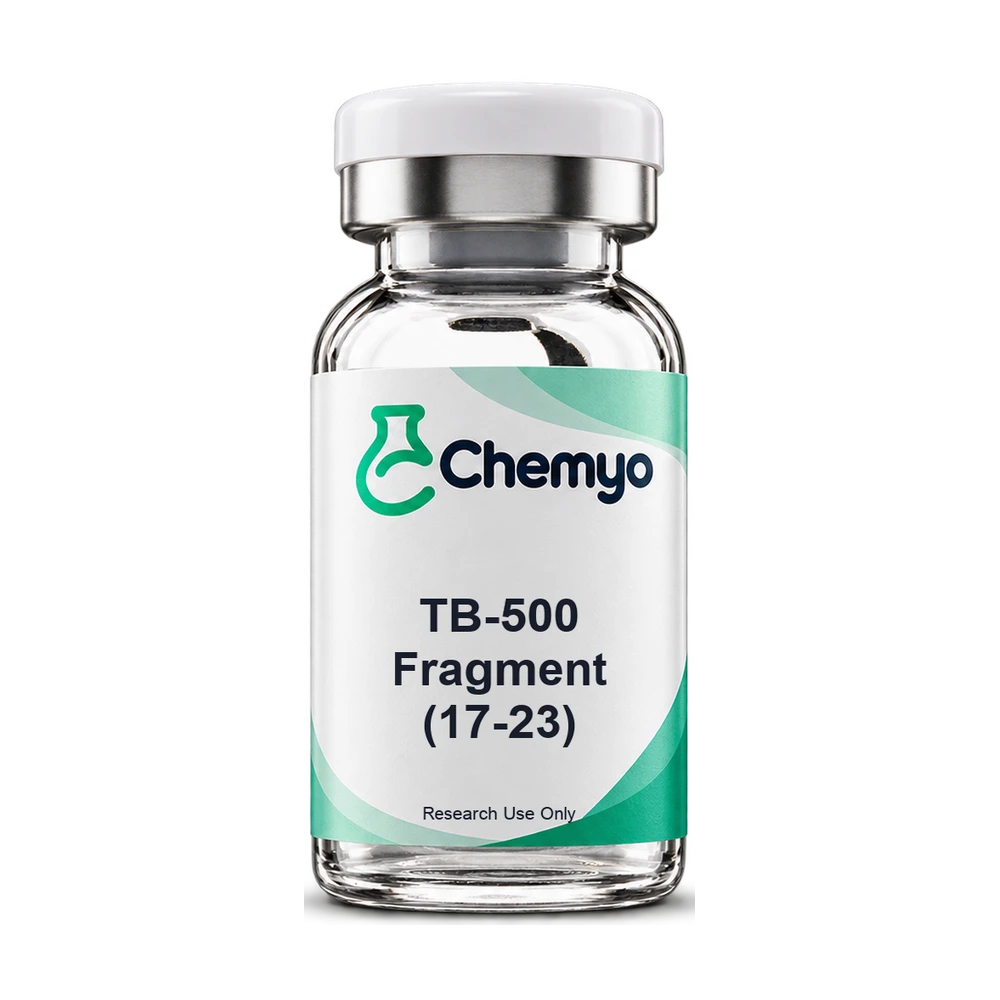
TB-500 Fragment (17-23) is a synthetic research peptide consisting of the key active amino acid sequence from the actin-binding region of thymosin beta-4.
Durante el cambio de envase, puedes recibir productos con la etiqueta anterior o con la nueva. La formulación, la pureza y la calidad siguen siendo exactamente las mismas, según nuestros estándares.
-25% en todo – hasta el 31 de octubre
25% sobre los precios habituales, en sustitución de otras ofertas. Acumulable solo con el descuento crypto.
Envío en el día para pedidos en EE. UU. realizados antes de las 12:00 EST.
Ver la política de envíos →Devoluciones sin complicaciones en 30 días para productos sin abrir.
Ver la política de devoluciones →Cada lote se analiza para comprobar su pureza, potencia y calidad.
Ver resultados de laboratorio →TB-500 Fragment (17-23) is a synthetic research peptide consisting of the key active amino acid sequence from the actin-binding region of thymosin beta-4. Supplied as a high-purity lyophilized powder, it’s used in laboratory research to study cellular migration, actin dynamics, angiogenic signaling, and tissue remodeling processes.
| Chemical Formula | C38H68N10O14 |
|---|---|
| Synonyms | TB-500 Fragment (17-23), Thymosin Beta-4 Fragment 17-23, LKKTETQ |
| Molar Mass | 889.02 g/mol |
| CAS Number | 885340-08-9 |
| PubChem CID | 62707662 |
| Total Compound Content | 10 mg per vial |
| Shelf Life | 36 months |
TB-500 Fragment (17-23) is the N-acetylated seven-residue sequence (Ac-Leu-Lys-Lys-Thr-Glu-Thr-Gln) corresponding to the LKKTET actin-binding motif found at position 17–23 of Thymosin Beta-4. Because this short sequence contains the core determinant of Tβ4's interaction with G-actin, it is frequently used in comparative studies examining whether a given cytoskeletal or signaling effect requires the full 43-residue protein or can be reproduced by the isolated binding motif alone.
Experimental work involving this fragment has focused on actin monomer sequestration assays, structure-activity mapping of the Tβ4 actin-binding domain, and mechanistic comparisons between the minimal fragment and full-length Tβ4 in cytoskeletal reorganization models. Because of its small size relative to full-length Tβ4, the fragment is also used in analytical chemistry and mass-spectrometry method development, including doping-control and peptide-identification research.
Every batch is independently lab tested for identity, purity and potency. View our lab testing program →
The Fragment (17-23) contains only the seven-residue LKKTET actin-binding motif that sits within the larger 43-residue Tβ4 sequence, rather than the full protein. It is typically used to test whether an observed effect of full-length Tβ4 depends on the whole protein or can be attributed to this minimal actin-binding region alone.
It's used mainly in comparative actin-binding and structure-function studies, where researchers assess G-actin interaction and cytoskeletal effects of the isolated motif relative to full-length Thymosin Beta-4. It also sees use in analytical/mass-spectrometry method development for peptide identification.
The name "TB-500" has been used inconsistently across the peptide supply industry — some vendors apply it to the full 43-residue Tβ4 analogue, while analytical and anti-doping literature identifies "TB-500" specifically as this Ac-LKKTETQ fragment. This listing is the isolated 7-residue fragment (CAS 885340-08-9); check formula and CAS number against any other "TB-500" product before comparing them directly.
Price was great and I got my delivery very quick in about 2 weeks to the US. Will def order again from here !!!
Nothing to complain. Simply amazing.
Highly satisfied with the ordering process and the chemical quality is top notch. A trustworthy supplier. The experimental results were exceptional.
Cannot recommend enough the ordering process and the compound is pure and high quality. Reordering next week. My laboratory research results exceeded expectations.
I'm very happy with the fast turnaround times, quality was great and dispatch was incredibly fast. Highly recommend this vendor. Our research results are completely exceeding expectations.
The experimental results were exceptional. Absolutely thrilled with the ordering process and the chemical quality is top notch. Thanks for the outstanding support!
My laboratory research results exceeded expectations. Absolutely thrilled with the support team and the compound is pure and high quality. A trustworthy supplier.
Exceptional service on the customer service and happy with the quality of this compound. Reordering next week. Our research results are completely exceeding expectations.